The Energy Industry Profile (EIP) of ISO 19115-1:2014 is an open, non-proprietary exchange standard for metadata used to document information resources, and in particular resources referenced to a geographic location, e.g., geospatial datasets and web services, physical resources with associated location, or mapping, interpretation, and modeling datasets.
Overview
The "Energy Industry Profile of ISO 19115-1:2014" (EIP), is an ISO Conformance Level 1 profile of the published international standard ISO 19115-1:2014. ISO 19115-1:2014 is the latest version of the mature conceptual specification ISO 19115:2003. The goals of the EIP are to:- Realize metadata standards and guidelines which enable stakeholders in the energy industry ("the community") to effectively and efficiently discover, evaluate and retrieve a diversity of information resources from widely distributed repositories and collections.
- Support both proprietary data management needs and exchange of data between and within organizations.
- Leverage existing standards to encourage adoption within the community and integration into the business and exploit existing organizational resources needed for governance and long-term maintenance.
- Diverse information resources with enough detail to enable their ready consumption, with no human intervention, if appropriate. Examples of such resources include structured and unstructured digital data, web services and physical assets like tapes, printed documents and samples.
- Geographic resources, in the form of place names or explicit spatial coordinates, to support discovery of location-specific resources. The initial focus of the EIP is on structured and unstructured information resources that contain explicit spatial coordinates, including GIS vector and raster datasets, subsurface application datasets and CAD maps.
Use Case Summary
Data Discovery and Recall
- Discovery: A user starting a project wishes to discover and identify relevant data from sources outside their company. Information about datasets is required to evaluate fitness for use and maximize its value. Standard metadata associated with the data enables users to search and discover data to locate appropriate, available resources without knowledge of locations, organization or naming conventions of the repositories in which the data are stored.
- Recall of Existing Data: A user new to the organization is asked to revisit an old project, and must gather and evaluate the data collected for the project given only information such as the area of interest (AOI) or project name.
Data Evaluation
- Evaluation of Data/Fit for Purpose: A user is reviewing prospect information and needs to evaluate data used to develop the prospect using criteria such as vintage, source, quality, accuracy, lineage, etc. Without metadata describing these, the user must seek out others who may be knowledgeable about the data, or make assumptions about data that may or may not be correct.
- On-going Data Updates: The velocity model used to process a seismic line is updated based on a new processing method, and all derivative cross sections and maps using the data need to be updated. In this case, updating the dependent data set requires knowledge of the processing lineage, including the complete hierarchy of relevant ancestors, as well as tools, methods and parameters used to process the data.
- Data Sharing: A user receiving data from a joint venture partner must be able to evaluate and determine the appropriate use of shared data. To accomplish this, the receiving organization must receive associated metadata along with the data for attributes such as status or quality.
Data Access
- Use Constraints: A knowledge worker needs to know the conditions under which they are permitted to access and use a particular dataset. Such conditions might include commercial licenses or government regulations. Metadata to standardize documentation of such use constraints would facilitate access to the information, encouraging and enabling compliance.
- Appropriate Use: A user needs to understand the intended or recommended use for a given dataset. Examples of this kind of metadata include scale-appropriateness and vintage.
EIP Standard components
EIP focuses on a subset of ISO 19115-1 packages as highlighted below.
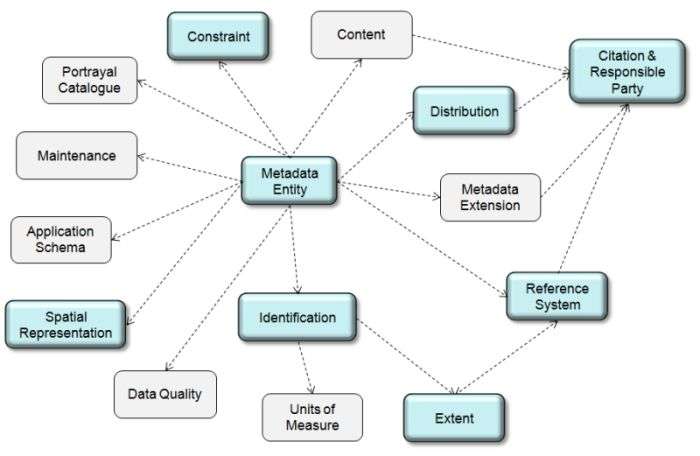
As a conceptual standard, ISO 19115-1 does not specify how it should be implemented. Conceptual specification dictates usage characteristics for each metadata element (e.g., obligation, cardinality, domain) which are independent of any implementation. Implementation of ISO 19115-1 as an XML encoding is specified by ISO 19115-3. To enable use of the EIP as an exchange standard, the EIP specification document includes both normative provisions that identify usage of ISO 19115-1 elements, and information needed to enable its implementation in XML using ISO 19115-3:2016.
Current version
EIP v1.1 is the current version.
Frequently Asked Questions about the Energy Industry Profile of ISO 19115-1:2014 standard.
What can be said about whether software vendors will support EIP in their products?
The commercial plans of software vendors are something that is out of scope for Energistics because of the need to maintain openness and commercial neutrality. Such questions should be directed to the vendor organizations.
Will there be a translation/mapping of EIP to other standards (Dublin Core, GML, FGDC)? Will tools/utilities be available to support conversion/translation of existing metadata?
The Metadata Work Group agrees that some mappings between EIP and other metadata formats could be very useful. Specific consideration of the development of selected mappings will be taken up by the Work Group based on the expressed interest and participation of those organizations that commit to become early adopters. Interested parties are encouraged to identify themselves. Note that internal communications will take place within Energistics to make other standards development groups aware of EIP and to determine the relevance of defining mappings with EIP and/or adaptations of internal metadata conveyed within the XML Schemas for the Energistics data exchange standards, including WITSML, PRODML, and RESQML.
Will tools for automated capture/creation of metadata be available from Energistics?
Energistics and the EIP work group believe automated capture or creation of metadata is highly dependent on the enterprise environment and the specifics systems and data management processes within each company or organization. We have no plans at this time to deliver tools related to automated capture/creation of metadata.
Will EIP support ontology?
There are intentions to address the use of keywords in a future version of EIP, including provision for qualifying keywords (names and values) with predefined contexts. It is possible that such contexts could be supplied through well-defined ontologies. Organizations with an interest in this area are encouraged to identify themselves as candidate participants for future EIP development work.
Will Energistics provide funding for purchasing copies of the ISO documentation for the base standard, ISO 19115-1?
Energistics will not fund copies of ISO 19115-1 documentation. The documentation may be purchased from several sources, including the ANSI web store or the ISO website.